
CE Compliance for Powersports Vehicles: A Model-by-Model EU Buyer Guide
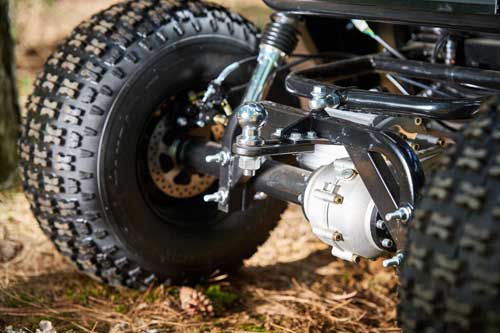
CE marking is a manufacturer's conformity declaration, not a quality award or a universal third-party certificate. For an ATV, UTV, Go Kart, Mini Bike or Dirt Bike, the correct EU/UK route depends on the vehicle classification, power system, intended use, applicable legislation, destination market and exact production configuration.
This guide helps dealers, distributors and importers build a defensible document request. It is educational information, not legal advice. Confirm the final route with the responsible manufacturer, an EU/UK compliance specialist or market-surveillance authority before placing products on the market.
Request a Model Documentation Review | View Products
Executive answer
Before accepting a CE claim, complete five checks:
- Identify the product and intended use, including gasoline, electric and battery-powered configurations.
- Map the exact EU legislation and standards that apply to that SKU; do not assume the Machinery Directive is the only instrument.
- Review the risk assessment, technical documentation, test evidence, instructions and Declaration of Conformity (DoC).
- Check the CE mark, manufacturer/importer details, traceability and language requirements on the actual unit and documents.
- Recheck the file after any design, supplier, battery, charger or software change.
The EU Machinery Directive 2006/42/EC remains a key reference during its application period. The Machinery Regulation (EU) 2023/1230 is scheduled to replace it from 20 January 2027; confirm the transition rules for the date and product being placed on the EU market.
1. CE marking: what it means
CE marking means the responsible economic operator declares conformity with all applicable EU harmonisation legislation. It does not mean that the EU has approved the product, that a Notified Body tested every unit, or that the product is durable or safe for every use.
The CE mark is required only when applicable EU legislation requires it. The mark, when required, must be visible, legible and indelible and must be accompanied by the information required by the applicable legislation. Confirm size, placement and exceptions from the relevant legal text; do not rely on a generic “5 mm” rule for every product.
2. Determine the legislation before testing
| Product feature | Possible legislation or evidence | Buyer action |
|---|---|---|
| Mechanical vehicle and moving parts | Machinery Directive 2006/42/EC or Machinery Regulation transition route, if in scope | Confirm classification, exclusions, essential requirements and conformity route |
| Electronic controls, displays, motor controller or BMS | EMC Directive 2014/30/EU, if in scope | Request EMC assessment and test evidence for the final configuration |
| Electrical/electronic components | RoHS 2011/65/EU, if in scope | Request material declaration or applicable conformity evidence |
| Battery-powered vehicle | Battery legislation, transport rules and product-specific safety evidence | Request battery/charger documents and current EU Battery Regulation assessment where applicable |
| Outdoor equipment or special use | Noise or other sector legislation, if the product falls within its scope | Confirm scope; do not add the Outdoor Noise Directive by default |
| Road-legal or type-approved vehicle | Separate vehicle/type-approval and national-use rules may apply | Confirm whether the product is off-road only or road approved in the destination country |
This is a screening table, not a legal classification. An importer should maintain a signed applicability matrix for each model and market.
3. Technical documentation and risk assessment
The technical file should allow a competent authority to understand the design, hazards, conformity route and evidence. Request, as applicable:
- product description, model and serial-number system;
- drawings, electrical diagrams and critical component list;
- product-specific risk assessment and risk-reduction measures;
- standards matrix with the clauses actually applied;
- test reports and calculations for braking, stability, guarding, noise, EMC and electrical safety where relevant;
- battery, charger and transport evidence for electric models;
- production-change and supplier-change records;
- user instructions and warnings in the language of each target market;
- signed EU Declaration of Conformity and authorized-representative/importer details where required.
Under the Machinery Directive route, technical documentation is generally retained for at least 10 years after the last unit is manufactured. Verify the retention rule under the legislation applicable to the product and placing-on-market date.
Risk assessment questions for powersports
Review moving chains and belts, hot surfaces, braking and stopping, throttle and kill controls, stability and rollover, electrical shock, battery damage, charging, fire, noise, vibration, maintenance, assembly, transport and foreseeable misuse. The assessment must describe the actual model, not a generic family paragraph.
4. Declaration of Conformity and marking
The DoC should identify the manufacturer, product/model, applicable legislation, standards used, signatory and date. It should match the unit, technical file, label, manual and shipment documents. A DoC for one model or configuration should not be copied to another without a documented review.
On the product and packaging, check:
- CE mark format and permanence;
- manufacturer name and contact address;
- importer or EU economic-operator details where required;
- model/type, serial or batch traceability;
- required warnings, battery symbols and charger information;
- manual and DoC language for the destination market.
5. UK market entry: Great Britain and Northern Ireland
The EU and UK are separate legal markets. Great Britain (England, Scotland and Wales) uses UK product legislation and may accept CE marking under current government arrangements for specified product categories. Northern Ireland follows different arrangements under the Windsor Framework and can require CE or CE plus UKNI depending on the conformity route.
Do not use “CE is accepted indefinitely” as a permanent promise. Check the current GOV.UK guidance for the product category, placing-on-market date, conformity-assessment body and marking combination. Keep a dated screenshot or PDF of the rule used for the shipment.
6. Model-specific buyer checklist
| Current model position | Documents to request before publication or order |
|---|---|
Go Kart: FR100GK, FR200GK-6, FR20DGK, FR60DGK-6 | Model DoC, risk assessment index, manual, EMC/electrical evidence where applicable, charger/battery documents for electric models, labels and final configuration |
ATV: FR125ATV-SP, FR60DATV-UT | Model DoC, technical-file index, risk assessment, manual, labels, battery/charger evidence for FR60DATV-UT, and destination-market review |
Mini Bike: FR100XMB, FR025DMB | Model DoC, risk assessment, manual, electrical/battery evidence for FR025DMB, labels and component-change status |
Electric Dirt Bike: FR08DEB | Battery voltage/capacity/chemistry, charger, BMS, UN 38.3 transport report, applicable EMC/RoHS/battery evidence, DoC, manual and label photos |
The table identifies a document request, not a statement that every model already has every certificate. Certification and conformity status must be confirmed by SKU, model year, configuration and destination.
7. Common mistakes
- Treating CE as a sticker without a technical file.
- Copying one DoC or risk assessment across different models.
- Failing to review a battery, charger, controller or software change.
- Supplying only English instructions to a non-English market.
- Assuming a test report is a certificate or that a Notified Body is always required.
- Confusing EU CE requirements with UKCA, type approval or local operating rules.
- Publishing “CE certified” without the certificate/DoC scope, date and model match.
8. 90-day implementation plan
Days 1–30: Build the evidence register
- List every SKU, configuration, destination market and economic operator.
- Request DoC, risk assessment index, manual, labels, test reports and change log.
- Create an applicability matrix for Machinery, EMC, RoHS, Battery and other legislation.
- Photograph the actual CE/traceability markings on sample units.
Days 31–60: Close product and document gaps
- Test or assess only the final production configuration.
- Translate manuals and warnings for each launch market.
- Review battery and charger evidence for
FR20DGK,FR60DGK-6,FR025DMB,FR08DEBandFR60DATV-UT. - Obtain written UK/GB/NI route confirmation for the intended shipment.
Days 61–90: Control production and launch
- Add conformity checks to the purchase order and pre-shipment inspection.
- Require approval before changing engine, motor, battery, charger, controller, frame or labels.
- Publish only model-specific claims supported by the approved evidence register.
- Audit the document set quarterly and before each new model year.
Frequently asked questions
Is CE a quality certification?
No. It is a conformity declaration under applicable EU legislation. Quality, durability, warranty and performance require separate evidence.
Does every powersports vehicle need a Notified Body?
Not necessarily. The conformity route depends on the legislation, product classification, standards and risk. Confirm whether self-declaration or third-party involvement applies to the exact product.
Can I use one CE certificate for all EverJoy models?
No assumption should be made. Request the DoC and technical evidence for each model and configuration. A document for one SKU does not automatically cover another.
Can CE marking be used for the UK?
Possibly, depending on the product category, market, date and current UK rules. Check Great Britain and Northern Ireland separately and retain the source used for the decision.
What should an importer request first?
Request the exact model DoC, technical-file index, risk assessment summary, manual, label photos, applicable test reports, battery/charger documents and a written change-control contact.
Request a CE documentation review
Send the destination country, model/SKU, power system, intended use, quantity, private-label changes and required launch date. EverJoy can prepare a model-specific document request and identify which claims still require confirmation.
CE/UKCA status, technical files, certificates, labels, safety features, prices, MOQ, lead time and availability are model-, configuration- and market-specific. Verify current documents before advertising, importing or placing a product on the market.
Source note: Use current EUR-Lex, European Commission, GOV.UK and applicable national market-surveillance guidance as the primary sources. This page intentionally avoids universal certification, cost, timeline and factory-capability claims.