
How to Import Powersports Vehicles from China: A US Buyer's Verification Guide

A practical, step-by-step guide for US dealers, distributors and importers — covering model selection, EPA/CPSC/CBP compliance verification, landed cost calculation, container loading, quality control, and after-sales setup.
Author: Mark Yu
Reviewed by: EverJoy Moto sourcing review team. Compliance, tariff and product-safety conclusions should be confirmed with the relevant agency, licensed customs broker, trade counsel or qualified testing professional.
Last updated: September 2026
Reading time: 12 minutes
Importing an ATV, Go Kart, Mini Bike or Dirt Bike from China involves more than finding a factory price. A successful order connects the exact model, destination-market compliance documents, landed cost, shipping plan, inspection standard, and after-sales support. Get these right, and you build a profitable import business with healthy margins. Get them wrong — missing EPA documentation, incorrect HTS classification, inadequate quality inspection — and you're looking at detained shipments, forced re-export, seized cargo, and lasting damage to your business.
This guide uses EverJoy Moto's current primary-model list as a planning reference: Go Kart (FR200GK-6, FR100GK, FR60DGK-6, FR20DGK), ATV (FR125ATV-SP, FR60DATV-UT), Gasoline Mini Bike (FR100XMB), Electric Mini Bike (FR025DMB), and Electric Dirt Bike (FR08DEB). Certification, tariff classification, prices, MOQ and availability must be confirmed for the exact SKU and shipment — no supplier certificate, market statistic, or online listing replaces the importer's own verification.
Request an Import Documentation Review | View Products
📌 Executive Answer: 6 Checks Before Paying a Deposit
Before paying any deposit, complete these verification steps:
- Define the customer job — use case, model, quantity, and destination state.
- Request model-specific documents — current technical sheet, manual, label photos, EPA/CARB certificate, GCC.
- Confirm tariff classification — HTS code, Section 301, AD/CVD scope with a licensed customs broker.
- Calculate landed cost — using a written freight quote, duty assumptions, and broker charges (not estimates).
- Approve a sample and inspection standard — before production begins.
- Put everything in the PO — model, configuration, documents, packaging, warranty, change control.
Table of Contents
- Choose the Product and Customer Job
- Supplier Due Diligence and Verification
- US Compliance: EPA, CPSC, CBP, and Trade Remedies
- Landed Cost Calculation
- MOQ, Payment Terms, and Purchase Order Controls
- Shipping and Container Loading Optimization
- Quality Control and Pre-Shipment Inspection
- Receiving, After-Sales, and EverJoy Moto Partnership
- 90-Day Importer Action Plan
- Frequently Asked Questions
- Sources
1. Choose the Product and Customer Job
Start by matching the product to a documented customer use case — not by picking the cheapest model from a catalog. Different buyer segments require different products, specifications, and compliance verification.
| Buyer Job | Initial EverJoy Model Group | Key Information to Verify |
|---|---|---|
| Family / outdoor Go Kart retail | FR100GK, FR20DGK | Seats, dimensions, speed, rider/load limits, warnings, operating area |
| Rental / entertainment Go Kart fleet | FR200GK-6, FR60DGK-6 | Duty cycle, controls, maintenance, parts availability, charging/fueling, fleet warranty |
| Single-rider ATV utility / work | FR125ATV-SP, FR60DATV-UT | Route, load capacity, tires, clearance, energy support, accessories, local rules |
| Compact recreational Mini Bike | FR100XMB, FR025DMB | Rider fit, seat height, speed, fuel/battery, supervision requirements, service plan |
| Electric off-road Dirt Bike | FR08DEB | Voltage, battery capacity, chemistry, BMS, charger, range test, transport classification, safety evidence |
This is a product-screening framework, not a safety, age, road-use, or performance guarantee. Each model's exact specifications, certifications, and suitability must be verified against the manufacturer's current technical sheet and applicable US regulations.
For dealers building a complete product line across categories, see our dealer product line planning guide.
2. Supplier Due Diligence and Verification
Choosing the right manufacturer is the single most important decision in the import process. A good supplier ensures compliance, quality, on-time delivery, and long-term partnership. A bad supplier results in detained shipments, defective products, and lost customers.
What to Request and Independently Verify
- Legal entity — company name, business registration, export license, and bank-account name match (all three should be the same entity).
- Model-specific documentation — exact technical sheet, bill of materials, user manual, production-change process, and label photos.
- Certificates — EPA Certificate of Conformity (verify the number on EPA's website), CARB EO (if applicable), CE/UKCA, GCC, and test reports. Confirm the certificate scope, model year, engine/battery family, and label match the exact product you're importing.
- Production evidence — sample photos, video, or an in-person visit showing the relevant production process and QC checkpoints.
- Quality records — QC checkpoints, inspection records, parts list, defect rate history, and warranty workflow.
- Commercial terms — MOQ, sample cost, lead time, packaging, Incoterm, payment milestones, and after-sales support.
Red Flags to Avoid
- No verifiable model-specific certificate or compliance document (pause the order and obtain a broker/legal review before shipment).
- Unwillingness to provide model-specific compliance documentation.
- Prices materially below comparable offers without a documented explanation for specification, Incoterm and warranty differences.
- Refusal of factory visits or third-party audits.
- Pressure to pay 100% upfront before production or document release.
Do not reject or approve a supplier based only on factory size, export percentage, or a claimed customer list. For material orders, use a signed factory audit or third-party inspection (SGS, Bureau Veritas, Intertek or TÜV); obtain the current scope and quotation directly from the inspection provider. For a detailed supplier evaluation framework, see our reliable powersports OEM supplier in China guide.
3. US Compliance: EPA, CPSC, CBP, and Trade Remedies
Regulatory compliance is the most critical — and most commonly mishandled — aspect of importing. Three US agencies have jurisdiction, each with distinct requirements. The following is informational only; confirm all requirements with your customs broker, trade counsel, and the relevant agencies for your specific products.
EPA: Emissions Certification
Gasoline-powered nonroad vehicles may be subject to EPA emission requirements under 40 CFR Part 1051 [1]. Key points to verify:
- Certificate of Conformity — the manufacturer must hold a valid EPA Certificate of Conformity for the specific engine family/model. Verify the certificate number on EPA's website and confirm you (or your import entity) are listed as an authorized importer, or obtain a letter of authorization from the manufacturer.
- EPA Form 3520-21 — typically required at the time of import entry for nonroad engines/vehicles. Confirm with your customs broker whether this form is required for your specific product classification [10].
- Emission label — each vehicle should carry an EPA emission control information label (typically on the frame near the engine) stating the engine family, certification number, and useful life.
- Electric models — require a separate classification review. Do not assume that "electric" removes every documentation or safety obligation — electric vehicles may still be subject to CPSC, battery transport, and other requirements.
CPSC: Safety Certification and eFiling
The US Consumer Product Safety Commission regulates consumer product safety. Key requirements to determine for your exact product:
- General Certificate of Conformity (GCC) — determine whether a GCC, children's-product testing, warning labels, or another CPSC requirement applies to the exact product and intended consumer. Requirements can depend on product design, age targeting, importer role, and applicable rules [2].
- eFiling — CPSC electronic certificate filing requirements depend on the applicable product rules, HTS code, importer role and current implementation guidance. Check the CPSC eFiling program and confirm timing with your broker. Powersports vehicles may fall under relevant HTS codes.
- Youth products — if importing youth ATVs, dirt bikes, or mini bikes intended for children under 16, additional CPSC requirements may apply (lead content limits under CPSIA, small parts, age labeling).
- Test basis — obtain the actual test basis and certificate data before shipment. Do not treat a generic GCC template as proof of compliance.
CBP: Customs Entry, HTS Classification, and Duties
CBP's official guidance on importing motor vehicles outlines the safety, bumper, and emissions standards that may apply to imported vehicles [11]. The importer is responsible for:
- Accurate HTS classification — each product must be classified under the correct Harmonized Tariff Schedule code, which determines the duty rate. Common categories include ATVs (8703.10), motorcycles/dirt bikes (8711.x by displacement), UTVs/side-by-sides (8703.x by engine size), and go-karts (verify classification — 9508.90 or other).
- Country of origin — accurately declared. For products manufactured in China, the country of origin is China.
- Entry documents — commercial invoice, packing list, bill of lading, entry summary (CBP Form 7501), and any required agency certifications.
Trade Remedies: AD/CVD on LSPTVs
A critical development: on June 17, 2025, the US Department of Commerce issued final affirmative determinations in antidumping (AD) and countervailing duty (CVD) investigations on low-speed personal transportation vehicles (LSPTVs) from China [4]. Key implications:
- Scope determination — the AD/CVD order covers certain low-speed vehicles. Determine whether your specific products fall within the scope — gasoline-powered ATVs, go-karts, and dirt bikes may or may not be covered depending on specifications. Obtain a written scope determination from your customs broker or trade counsel.
- EAPA enforcement — CBP is actively investigating evasion, including transshipment through third countries and misclassification of vehicles as "parts." In August 2026, CBP initiated an EAPA investigation (Cons. Case 8286) into evasion of AD/CVD on Chinese-origin LSPTV subassemblies [5].
- Do not classify a complete vehicle as "parts," transship through a third country to change origin, or publish a duty rate without a written classification basis.
Maintain the broker's ruling, scope analysis, entry documents, and product specifications in one shipment file for at least 5 years.
4. Landed Cost Calculation
Use actual, dated values — not estimates or rules of thumb.
Landed cost = product price + packaging + inland China charges + ocean/air freight
            + insurance + duty/trade remedies + MPF/HMF + broker fees
            + inspection + inland US delivery
Gross margin % = (net selling price - landed cost - variable selling cost) / net selling priceDo not use universal "30–50% cheaper" claims, fixed MSRP assumptions, or generic margin/MOQ figures. The result changes with HTS code, origin, destination, season, order volume, Incoterm, exchange rate, and warranty reserve.
As a planning reference only (as of September 2026 — verify with your broker and freight forwarder):
| Cost Component | Typical Range (per 40ft container) | Notes |
|---|---|---|
| Ocean freight (China → US West Coast) | $2,000–$3,800 | Peak season (Aug–Oct) 40–80% higher [6][7] |
| Ocean freight (China → US East Coast) | $2,800–$5,000 | Verify current rates before ordering [6][7] |
| Insurance | 0.1–0.3% of shipment value | Typically 110% of invoice value |
| MPF (Merchandise Processing Fee) | 0.3464% of entered value | Min $31.67, max $614.35 (2026) |
| HMF (Harbor Maintenance Fee) | 0.125% | Ocean shipments only |
| Customs broker fee | $100–$300 per entry | Varies by broker and complexity |
| Pre-shipment inspection | $200–$500 | Third-party (SGS/BV/Intertek/TÜV) |
These are planning estimates, not quotations. Obtain a written landed cost calculation from your customs broker and freight forwarder before committing to an order.
5. MOQ, Payment Terms, and Purchase Order Controls
MOQ
MOQ is project-specific — ask for separate terms for standard stock, mixed orders, private label, battery products, and major engineering changes. Confirm current EverJoy terms in writing before budgeting inventory; do not use a historical or internal MOQ as a universal promise.
Payment Terms
Standard arrangements include:
- 30% deposit + 70% balance before shipment — most common. Deposit funds raw materials and production; balance due after production completion and pre-shipment inspection.
- 30% deposit + 70% against copy of B/L — balance paid after shipment, providing slightly more buyer security.
- L/C (Letter of Credit) — for large orders ($50,000+), provides security for both parties. Bank fees typically $500–$1,500.
For a first order, consider linking the balance payment to an agreed inspection result and document release, subject to the supplier contract and broker advice. Never pay 100% upfront to a new supplier.
Purchase Order Must Include
- Exact model, revision, quantity, and approved configuration (with photos/spec sheet attached).
- Unit price, currency, Incoterm, deposit and balance trigger.
- Packaging, labels, manuals, certificates, and shipping documents required.
- Sample approval reference, inspection standard, nonconformance remedy, and rework terms.
- Spare parts, warranty response, change notification, and cancellation terms.
6. Shipping and Container Loading Optimization
Choose FCL or LCL based on measured packed volume and weight — not a generic unit count.
Container Specifications (reference only)
| Container Type | Volume | Typical ATV Count (SKD) | Typical Go-Kart Count (SKD) |
|---|---|---|---|
| 20ft Standard | ~33 CBM | 6–10 units | 12–20 units |
| 40ft Standard | ~67 CBM | 14–22 units | 25–40 units |
| 40ft High Cube | ~76 CBM | 16–25 units | 28–45 units |
Counts are estimates for standard-size vehicles with partial disassembly. Actual counts depend on vehicle dimensions, packaging method, and loading configuration — request a loading diagram from your supplier.
Before Booking Freight, Request
- Packed dimensions and gross/net weight per carton or skid.
- CBU (Complete Built Up) or SKD (Semi-Knocked Down) assembly plan and reassembly responsibility.
- Battery transport classification and UN 38.3 documents for lithium products.
- Loading diagram, photos, moisture protection, and securing method.
- Commercial invoice, packing list, origin information, and broker instructions.
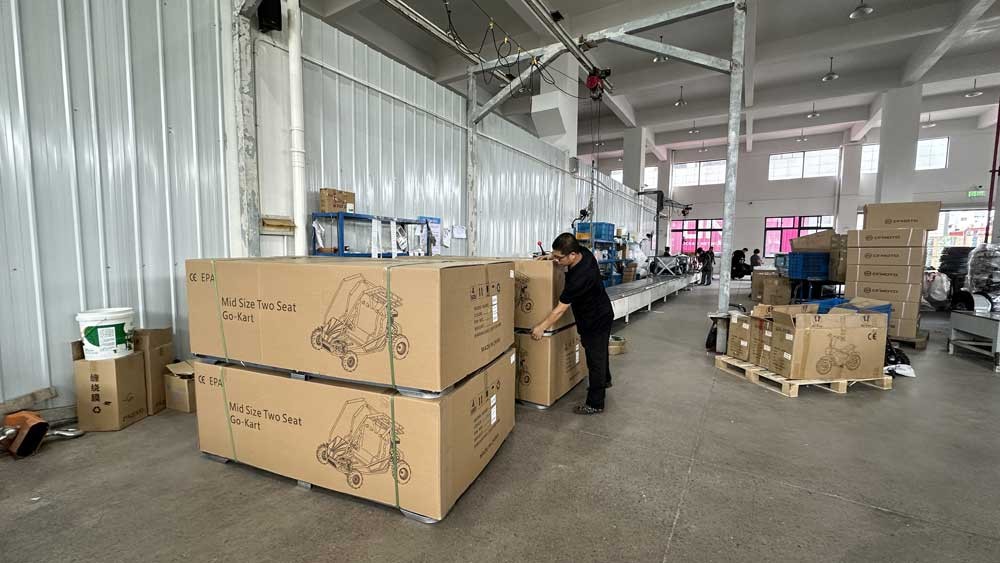
SKD vs CBU
Partial disassembly (SKD — removing front wheels, handlebars, racks) may improve cube utilization by 20–40% compared to fully assembled (CBU) shipping [6][8]. However, SKD adds: reassembly labor at destination (typically 15–30 min/unit), increased damage risk from more handling, and additional documentation obligations (customs must accurately reflect the SKD configuration). Evaluate the tradeoff for your specific products and assembly capacity.
FCL vs LCL Break-Even
- FCL — typically more cost-effective at 12–15+ CBM (roughly 8+ ATVs or 15+ go-karts). Cheaper per CBM, less handling damage, faster transit.
- LCL — for smaller shipments (<12 CBM). More flexible but $80–$220/CBM (vs. $35–$65 effective FCL rate), higher damage risk, and 5–10 days slower [6][12].
Current ocean freight rates (as of Q3 2026, planning reference — verify with your forwarder): 40ft FCL China→US West Coast $2,000–$3,800, East Coast $2,800–$5,000; LCL $80–$150/CBM West Coast, $120–$220/CBM East Coast [6][7]. Peak season (August–October) rates run 40–80% higher.
 |
|---|
Figure 1: Container loading optimization — comparing SKD vs CBU loading, FCL vs LCL cost per unit, and volume/weight balance for powersports vehicles.
7. Quality Control and Pre-Shipment Inspection
Quality control separates a successful import business from one plagued by defects, returns, and customer complaints. Use three checkpoints for a new supplier or model:
Three-Stage QC Process
- Sample approval — measure the model, verify function, packaging, labels, and documents against the spec sheet. This is the baseline for production.
- During-production check (DUPRO) — confirm critical components, configuration, quantity, and corrective actions from the sample stage. Catch issues early before they're replicated across the entire order.
- Pre-shipment inspection (PSI) — when 100% of production is complete and 80%+ packed: inspect finished units, start/run or power systems (where safe), brakes, controls, fasteners, cosmetics, packaging, and document sets.
For Go Kart fleet orders, add duty-cycle, charging/fueling, spare-parts, and operator-procedure checks. For electric products, add battery identity, charger match, BMS evidence, transport documents, and damaged-pack handling.
Third-Party Inspection
For most importers, hiring a third-party inspection company is the most practical approach:
- SGS, Bureau Veritas, Intertek, TÜV — global companies, $300–$500/man-day.
- Local China inspection companies (AsiaInspection, QIMA, InTouch) — $150–$300/man-day.
A standard 40ft container PSI typically takes 1 man-day ($200–$500) — a tiny fraction of container value (0.1–0.5%) and the best insurance against quality issues.
If Inspection Fails
- Document everything (photos, videos, written report).
- Notify the manufacturer immediately and require corrective action.
- Determine severity — minor cosmetic issues may be acceptable with a price concession; major functional defects require rework or replacement.
- Require re-inspection before approving shipment — don't accept the manufacturer's word that issues are fixed.
- Withhold balance payment if contract allows; escalate to dispute resolution if needed.
It is always cheaper to fix quality issues at the factory than after the goods arrive in the US.
 |
|---|
Figure 2: The three-stage quality control process — Sample Approval, During-Production Check (DUPRO), and Pre-Shipment Inspection (PSI), showing defect detection rates and cost-of-fix impact at each stage.
8. Receiving, After-Sales, and EverJoy Moto Partnership
Receiving at Your US Warehouse
- Photograph the container and cartons before unloading.
- Reconcile quantity against the packing list.
- Record any damage and quarantine nonconforming units.
- Notify the carrier/insurer within the contract deadline (typically 48–72 hours).
- Keep the model, serial, certificate, entry, and inspection records together for at least 5 years.
After-Sales Setup
Prepare a parts and warranty plan before retail launch. The dealer should know:
- Who supplies diagnostic information and technical support.
- Which parts are stocked locally (set a reserve from actual failure history, lead time and service commitments).
- How a battery or engine warranty claim is assessed and approved.
- Who approves field changes or product updates.
EverJoy Moto: Your China-Based Manufacturing Partner
EverJoy Moto (Jinhua EverJoy Technology Co., Ltd.) is a China-based powersports supplier supporting gasoline and electric ATV, UTV, Go Kart, Dirt Bike and Mini Bike projects. Factory scope, export history, capacity, certificates, MOQ and lead time should be verified from current company documents and the buyer's audit process.
What we provide:
- Model documentation support — current technical sheets, applicable certificates or declarations, labels, invoices, packing lists and shipping documents for the selected SKU. For EPA-specific details, see our EPA compliance guide for ATVs and UTVs.
- Export logistics review — packing and SKD options, loading plan, Incoterm and freight-forwarder coordination confirmed per shipment.
- Project-specific commercial terms — quotation, deposit, balance trigger, MOQ, sample and lead time stated in writing.
- Quality-control planning — incoming, in-process and pre-shipment checks agreed in the purchase order.
- OEM/ODM review — colors, decals, packaging and engineering changes assessed for feasibility and compliance impact. For private label planning, see our step-by-step private label powersports brand guide.
- After-sales planning — parts catalog, warranty workflow, technical contact and response expectations defined for the project.
For European market entry, see our CE certification guide for powersports vehicles. For electric model-specific considerations, see our electric dirt bike battery technology guide.
9. 90-Day Importer Action Plan
Days 1–30: Research and Supplier Selection
- [ ] Shortlist models and customer jobs, starting with the Go Kart core lineup (
FR100GK,FR20DGKfor entry;FR200GK-6,FR60DGK-6for fleet). - [ ] Collect technical, safety, battery, and compliance documents by SKU.
- [ ] Obtain broker classification and trade-remedy (AD/CVD) scope review.
- [ ] Compare supplier quotations on a landed-cost basis (not FOB price alone).
- [ ] Order sample units from 1–2 shortlisted suppliers.
Days 31–60: First Order and Production
- [ ] Approve samples and define inspection standards.
- [ ] Negotiate PO: warranty, parts, change-control, payment terms.
- [ ] Finalize packaging, labels, manuals, freight, and shipment documents.
- [ ] Pay 30% deposit and confirm production start date.
- [ ] Conduct during-production check (DUPRO) at 30–50% completion.
Days 61–90: Inspection, Shipping, and Clearance
- [ ] Complete pre-shipment inspection (PSI) and document reconciliation.
- [ ] Address any defects (rework/re-inspection) before approving shipment.
- [ ] Pay 70% balance and confirm container loading.
- [ ] File CPSC GCC eFiling and EPA Form 3520-21 (if required) before arrival.
- [ ] Monitor customs entry and coordinate duty payment with broker.
- [ ] Conduct receiving inspection at warehouse; file damage claims within deadline.
- [ ] Measure damage, defects, inquiry rate, sample conversion, and warranty issues.
- [ ] Adjust reorder quantity based on qualified demand, not page traffic alone.
90-Day Targets
| KPI | Starting Point | 90-Day Target |
|---|---|---|
| Suppliers evaluated | 0 | 3+ (1 primary + 1 backup) |
| Sample units evaluated | 0 | 2–4 units |
| First order placed | 0 | 1 PO (10–50 units) |
| Compliance documentation | None | Complete set per SKU |
| Customs broker relationship | None | Established (powersports experience) |
| Container received | 0 | 1 container received and inspected |
| Quality defect rate | Unknown | <3% (target) |
| Landed cost per unit | Estimate | Actual, documented |
10. Frequently Asked Questions
What should I import first?
Start with the model that matches a documented customer job and your service capability. For EverJoy's current range, Go Kart is the core category — compare FR100GK/FR20DGK for entry-level retail conversations and FR200GK-6/FR60DGK-6 for higher-output or fleet discussions, after verifying specifications and compliance for your destination market.
Does an EPA, CE, or CPSC document cover every model?
No. Documents are scope-specific. Verify model, configuration, model year, responsible party, and destination-market applicability for each SKU. A certificate for one engine family does not automatically cover a different model or model year.
How many units fit in a container?
Ask the supplier and forwarder to calculate from final packed dimensions, weight, CBU/SKD method, and securing plan. A generic unit count is not a quotation. As a planning reference, a 40ft container typically holds 14–22 ATVs or 25–40 go-karts in SKD configuration — but verify with your supplier's loading diagram.
Can I start with a small order?
Possibly. MOQ, mixed loading, samples, and private-label terms are project-specific. EverJoy Moto offers trial orders of 10–20 units for new customers (company internal data, 2025 fiscal year), but confirm current written terms before budgeting inventory.
What is the biggest importing mistake?
Paying against an unverified model and document set. Confirm classification, compliance, landed cost, sample quality, and inspection terms before production begins. A $300 pre-shipment inspection that catches $5,000 in defects is one of the highest-ROI investments in importing.
Do I need an import license?
There is no general "import license" for powersports vehicles. However, you typically need: an EPA-authorized importer relationship, CPSC GCC filing capability (via your broker), a customs bond (continuous bond ~$500/year or single-entry), and an IRS EIN if importing regularly. Confirm with your customs broker.
How long does the import process take?
For a standard order with an established manufacturer: production (30–45 days) + inspection (3–7 days) + ocean freight (14–25 days West Coast, 25–35 days East Coast) + customs clearance (3–7 days) + inland delivery (2–7 days) = approximately 7–13 weeks total. First-time orders add 2–4 weeks for supplier evaluation and samples. Peak season may add 1–2 weeks.
Sources
[1] US Environmental Protection Agency (EPA) — 40 CFR Part 1051 (Control of Emissions from Nonroad Recreational Engines and Vehicles), Part 1065 (Testing Procedures), Part 1068 (General Compliance Provisions) — emission standards, certification requirements, useful life, importation requirements — EPA, current regulations.
[2] US Consumer Product Safety Commission (CPSC) — current Certificate of Compliance and eFiling guidance. Check the current implementation date, covered products and filing workflow before entry.
[3] RTS Lab — "CPSC eFiling Mandate Takes Full Effect July 8, 2026 – Complete Compliance Guide" — eFiling rules, timelines, required data, preparation steps; CPSC final rule published January 8, 2025 — published June 23, 2026.
[4] International Trade Administration (ITA), US Department of Commerce — "EC AD CVD Final Determinations of Low-Speed Personal Transportation Vehicles from China" — final affirmative determinations in AD/CVD investigations on LSPTVs from China, announced June 17, 2025 — trade.gov.
[5] US Customs and Border Protection (CBP) — "EAPA Cons. Case 8286: Various Importers (Notice of Initiation of Investigation and Interim Measures, August 25, 2026)" — investigation into evasion of AD/CVD on Chinese-origin LSPTV subassemblies and parts via transshipment through Vietnam/Thailand — CBP, August 31, 2026.
[6] Suaid Global — "Ocean Freight Rates 2026: Complete Pricing Guide" — 40ft container China to US West Coast $2,000–$3,800, East Coast $2,800–$5,000; peak season (August–October) rates 40–80% higher — published April 5, 2026.
[7] Vantage Forwarding — "Cost of Sea Freight from China to USA 2026" — 20ft FCL $2,500–$7,000, 40ft/40HC $3,500–$9,000 base ocean freight; figures vary by ports and market conditions — updated September 1, 2026.
[8] CHINAISPP — "China to USA Shipping Costs and Customs | Import Guide 2026" — FCL vs LCL comparison: 20ft ~28 CBM, 40ft ~58 CBM; LCL more flexible but higher per-CBM rates — published July 1, 2026.
[9] Market research data — global powersports market projected to reach $28.29 billion by 2030, CAGR 6.8% from 2024 — aggregated from multiple industry research reports (Grand View Research, Fortune Business Insights, Market Research Future).
[10] US EPA — "Learn About Importing Vehicles and Engines" — Clean Air Act prohibits importation of nonroad engines/vehicles not conforming to EPA emission standards; applies to recreational vehicles (dirt bikes, ATVs) whether new or used — EPA.
[11] US Customs and Border Protection (CBP) — "Importing a Motor Vehicle" — imported vehicles subject to safety standards (Motor Vehicle Safety Act), bumper standards, and air pollution standards (Clean Air Act); importer responsibilities — CBP, updated May 21, 2026.
[12] Dantful Logistics — "Cost of Shipping from China to USA" — LCL rates $80–$150/CBM; Gulf Coast container $2,800–$5,200; shipping method cost comparison — published June 8, 2026.
[13] US Consumer Product Safety Commission — current Certificate of Compliance and eFiling guidance. Verify the covered products, filing workflow and effective date directly with CPSC before entry.
[14] GovInfo — Federal Register Volume 90, Number 118 (June 23, 2025) — Commerce final determination imposing certification requirements for LSPTV components (seat assemblies, steering columns, suspension systems, plastic cowlings, motors) from China — Federal Register, 2025.
[15] GovInfo — 19 CFR 12.73 — "Entry of Motor Vehicles, Engines, and Equipment Containing Engines Under the Clean Air Act" — customs entry requirements for imported vehicles and engines under EPA regulations — Code of Federal Regulations.
Ready to Start Importing?
Send the destination state, model(s), use case, quantity, target launch date, private-label needs, and required documents. EverJoy can prepare a model-specific sourcing and document checklist for your quotation.
Request an Import Documentation Review | View Products | Download the Importer Checklist
Prices, MOQ, lead time, duties, certifications, safety features, shipping capacity and availability are model-, project- and market-specific. Confirm current information with the supplier, broker, agencies and qualified advisers before importing or selling. The freight rates, duty estimates, and timeline projections in this guide are planning references as of September 2026 and may not apply to your specific products, order volume, or shipping routes.
Source note: Use current EPA, CPSC, CBP, USITC HTS, Department of Commerce, and official carrier guidance as primary sources. This page intentionally avoids unsupported universal tariff, certification, cost, capacity, and performance claims — all specific figures are labeled as planning references and should be verified with your broker and supplier for each shipment.
Disclaimer: This article is for educational and informational purposes only and does not constitute professional legal, customs, trade, or regulatory advice. Importing powersports vehicles involves complex regulatory requirements under EPA, CPSC, CBP, and other agencies, as well as evolving tariff and trade enforcement policies (including AD/CVD on LSPTVs). Importers should consult with qualified customs brokers, trade attorneys, compliance specialists, and logistics professionals for specific product determinations and import planning. The regulatory information cited is from the sources listed above and is accurate as of their respective publication dates; regulations, tariffs, and enforcement policies may be updated or revised.
This article was written by Mark Yu and reviewed internally for sourcing workflow. EverJoy Moto (Jinhua EverJoy Technology Co., Ltd.) supports powersports sourcing and OEM/ODM projects. Certification, pricing, capacity, MOQ, lead time and import eligibility are model-, project- and market-specific; verify current documents with the supplier, agencies, broker and qualified advisers.